




Scientific articles
Check out the main scientific publications that mention Angelus products.
Microstructural composition, ion release, and bioactive potentialof new premixed calciumsilicate–based endodontic sealers indicated for warm vertical compaction technique
ABSTRACT:
The calcium silicate–based sealers considered in the present in vitro study exhibited a high calcium ion release, adequate cytocompatibility, upregulated osteo/cementogenic gene expression, and increased mineralized nodule formation in contact with hPDLCs. Clinical relevance From a biological perspective, BCI and BCHiF could be clinically suitable for root canal filling.
REFERENCE:
SANZ, J.L.; ET AL. Microstructural composition, ion release, and bioactive potential of new premixed calciumsilicate–based endodontic sealers indicated for warm vertical compaction technique. Clin Oral Invest DOI 10.1007/s00784-020-03453-8, JUL 2020.
Comprehensive review of current endodontic sealers
ABSTRACT:
Compared to AH Plus, tricalcium silicate sealers show the lowest relative microleakage among the sealers assessed, followed by silicone sealers and other non-AH Plus epoxy resin sealers. Tricalcium silicate sealers also exhibit the most favorable antimicrobial effect and excellent biocompatibility. Future sealers developed should ideally combine a hermetic seal with therapeutic effects.
REFERENCE:
KOMABAYASHI, .; ET AL. Comprehensive review of current endodontic sealers. Dent Mater J 2020;Mar 24. doi: 10.4012/dmj.2019-288.
A laboratory evaluation of cell viability, radiopacity and tooth discoloration induced by regenerative endodontic materials
ABSTRACT:
The new bioceramic material (BT) had acceptable cell viability, similar to that of MTA and UC at the highest dilutions, and BT resulted in less tooth colour change than MTA and UC. Despite its lower radiopacity, BT was identified radiographically.
REFERENCE:
OLIVEIRA, L.V.; ET AL. A laboratory evaluation of cell viability, radiopacity and tooth discoloration induced by regenerative endodontic materials. International Endodontic Journal, 53, 1140–1152, 2020.
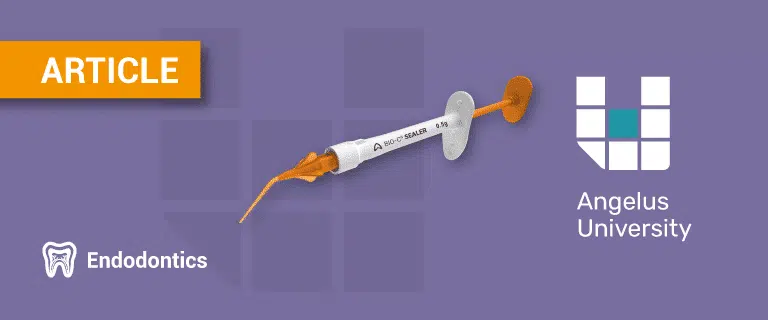
Obturación endodóntica de las raíces mesiales de molares inferiores con sellador Bio-C Sealer y AHPlus
ABSTRACT:
No se encontraron diferencias significativas en el volumen de obturación entre las muestras tratadas con sellador AH Plus y sellador Bio C- Sealer (p>0,05). Respecto al volumen de espacios vacíos, la frecuencia de casos en los cuales pudieron detectarse volúmenes de vacíos mensurables (≥ 0,01 mm3) fue del 15%; registrándose 2 en el grupo BIO-C sealer (5%) y 4 en AH Plus (10%).
REFERENCE:
HERNADEZ. P.A.; ET AL. Obturación endodóntica de las raíces mesiales de molares inferiores con sellador Bio-C Sealer y AHPlus. Rev. Methodo 2020;5(4):129-135.
Cimentos biocerâmicos de terceira geração
ABSTRACT:
Conclui-se que os cimentos biocerâmicos demostraram ser promissores, uma vez que suas propriedades físico--químicas não somente respondem aos padrões das normas ISO, mas também superam em alguns aspectos o cimento AH Plus, justificando sua aplicação clínica.
REFERENCE:
MONJE, M.E.N.; ET AL. Cimentos biocerâmicos de terceira geração. SALUSVITA, Bauru, v. 39, n. 3, p. 843-876, 2020.
Dentinal Tubule Penetration and Adaptation of Bio-C Sealer and AH-Plus: A Comparative SEM Evaluation
ABSTRACT:
Under the parameters of this study, BIOC exhibits higher penetration and better adaptation to the dentinal tubules compared to AHP.
REFERENCE:
CACERES, C.; ET AL Dentinal Tubule Penetration and Adaptation of Bio-C Sealer and AH-Plus: A Comparative SEM Evaluation. EUR Endod J 2021. Published online: 22 April 2021 DOI 10.14744/eej.2020.96658.
Antibacterial Activity of a New Ready- To-Use Calcium Silicate-Based Sealer
ABSTRACT:
Fresh Bio-C Sealer exhibited antimicrobial activity against all bacteria evaluated by agar diffusion method, except for S. mutans. Set discs of all endodontic sealers tested showed similar CFU values for E. faecalis (p>0.05). S. mutans in biofilms showed higher susceptibility to EndoFill compared with the other sealers (p<0.05). In conclusion, the results indicate that fresh Bio-C Sealer does not inhibit S. mutans growth, but exhibits antibacterial activity against E. faecalis, S. aureus, P. aeruginosa and E. coli. After setting, the Bio-C Sealer exhibits an antimicrobial potential comparable to that of the other sealers evaluated in E. faecalis biofilm, but lower than that of EndoFill for S. mutans biofilm.
REFERENCE:
BARBOSA, V.M.; ET AL. Antibacterial Activity of a New Ready- To-Use Calcium Silicate-Based Sealer. Brazilian Dental Journal (2020) 31(6): 611-616.
Biocompatibility and Bioactive Potential of New Calcium Silicate–based Endodontic Sealers: Bio-C Sealer and Sealer Plus BC
ABSTRACT:
BC and SPBC are biocompatible to be used in close contact with periapical tissue, inducing a mild inflammatory reaction and favoring repair. In addition, both sealers may contribute to the periapical tissue mineralization process because they demonstrate bioactive potential.
REFERENCE:
LOPES, L.D.S., ET AL. Push-out bond strength and failure mode of single adjustable and customized glass fiber posts. Saudi Dental Journal (2021) 33, 917–922.
Push-out bond strength and failure mode of singleadjustable and customized glass fiber posts
ABSTRACT:
SAP showed better performance than CP. The root third and resin cements did not influence the PBS. The most prevalent failures were adhesive and mixed. Push-out bond strength.
REFERENCE:
LOPES, L.D.S., ET AL. Push-out bond strength and failure mode of single adjustable and customized glass fiber posts. Saudi Dental Journal (2021) 33, 917–922.

SAC
Specialized Customer Service
Monday to Friday, from 7:30 a.m to 5:30 p.m (GMT-3).


